

What is waste? Clothes made from oil… or clothes made from sheep?
Turns out, the answer has already been decided for us by the fashion industry. Yeah, the same industry that convinced us that shoulder pads were a good idea.
Today, it's deciding which fibers live and which get tossed. And that's how I found myself thinking about wool in a tiny Austrian village.
Such a nice material like wool… is thrown away.
That's the short answer. But here's the long one: Did you know… in Europe, we literally burn wool? Not for warmth. Not for some cozy pagan ritual. We burn it because… we call it "waste". The same fiber that clothed our ancestors through ice ages, wars and migrations. Today? Tossed aside, forgotten, buried in landfills.
Meanwhile, we proudly wrap ourselves in "eco" sweaters made from recycled plastic bottles. Plastic that will outlive me, you and your grandma's cookie recipe. That's not fashion. That's amnesia.
Hi, I'm Tori. This is Curious by Design, a VOCA special. I'm a software engineer, a multicultural storyteller and, yes, a woman unreasonably obsessed with looking and feeling good in clothes: the choosing, the styling, the tiny daily theater of it all. But I’m no longer in denial about what they actually cost.
This episode? It's about memory. What we keep. What we throw away. And what wool (yes, wool) can teach us about the future of fashion.
Let me take you somewhere.
It's July, in a tiny Austrian village with fewer than 300 people. I'm sitting in a circle of women, feet on damp grass. It feels like summer camp, except instead of braiding friendship bracelets, we're sharing stories.
The group goes quiet. And then I hear it:
Human beings and sheep live together since 10,000 years.
From that moment, I realized this conversation wasn’t just about clothes. It was about centuries of human connection, craftsmanship and the stories embedded in every fiber.
The lady talking is Gabriele, a textile engineer with 30 years' experience, with her curly silver hair framing a face that seems to glow with wonder. She spins wool by hand, slowly, as if she's decoding Braille from the past.
Why I'm spinning with this hand spindle is because it's so slow. And for me that's so wonderful. Because in our time everything has to be so fast. The only way to survive this hurry-up mentality… is to slow down.
Slow. Down. That hit me. I thought of my student days in Sweden, where we'd meet for fika and knit together, draw, play music, talk, just be slow together. And here I am now, gulping hot chocolate while doomscrolling.
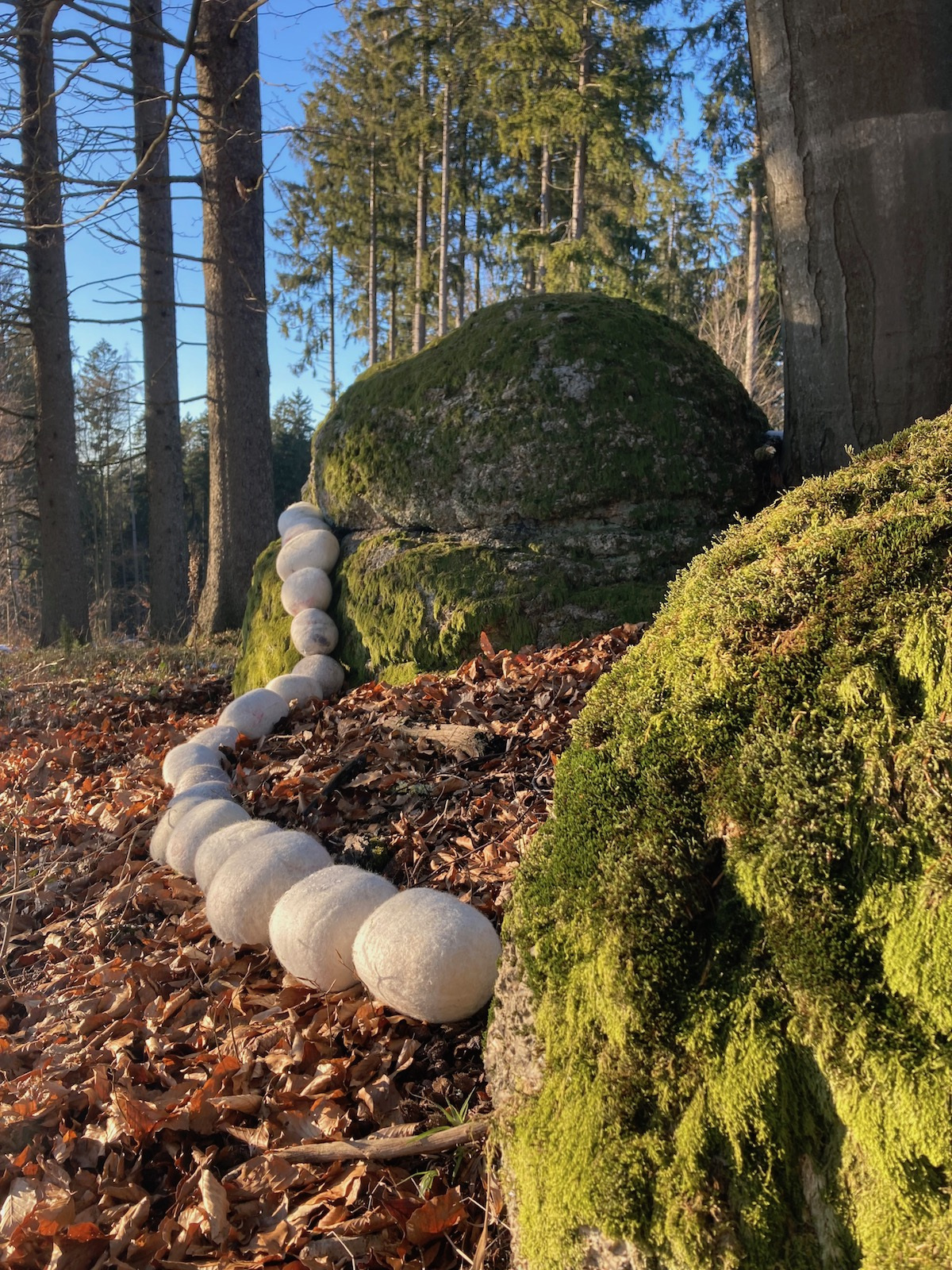
Gabriele shows me pictures of her installation, Steinreich - "Stone-Rich". It's a field of 300 objects made from discarded wool and family textiles. They look like grey river stones. Solid. Familiar. Heavy. If you touched them, you would feel wool at your fingertips. Peek inside, and you would see generations of clothes.
But these stones are more than art. They are a question: what are we really passing down? Wealth? Or waste?
Gabriele looked through her family's clothes, sorted them and found pieces carrying decades of life. I bet you've noticed it too: old clothes just hold up better. Your dad's t-shirt, your grandma's coat… they carry more life than most of what we buy today.
For Gabriele, they were trousers her grandfather wore at his wedding, then for work… for forty years. And now? She wears them while gardening. That's the kind of loyalty I wish for my future husband to have. Honestly, if my clothes could last longer than a New Year's resolution, I'd sign them up for a TED Talk on endurance.
These trousers are a symbol of how we developed back, not forward.
100 years ago, clothes were slow. Sewn by hand. Repaired. Cherished. Passed down.
Today? Most of us don't even know how to sew on a button.
We treat clothes like napkins. One spill, one season and they're gone. When was the last time you mended a shirt or really thought about where your sweater came from? And here’s the punchline: we call wool "waste" while paying €5 for polyester T-shirts, the same price as a latte.
Gabriele wanted to show this irony in art. She chose clothes that had been worn and repaired so many times that they had reached the end of their life. True waste. A reminder of how our ancestors treated clothing: nothing was disposable. Every shirt was patched. Every dress was altered again and again to fit new bodies and new moments in life. Every sock darned until the fabric itself gave up. Clothes were lived in, lived with and passed down.
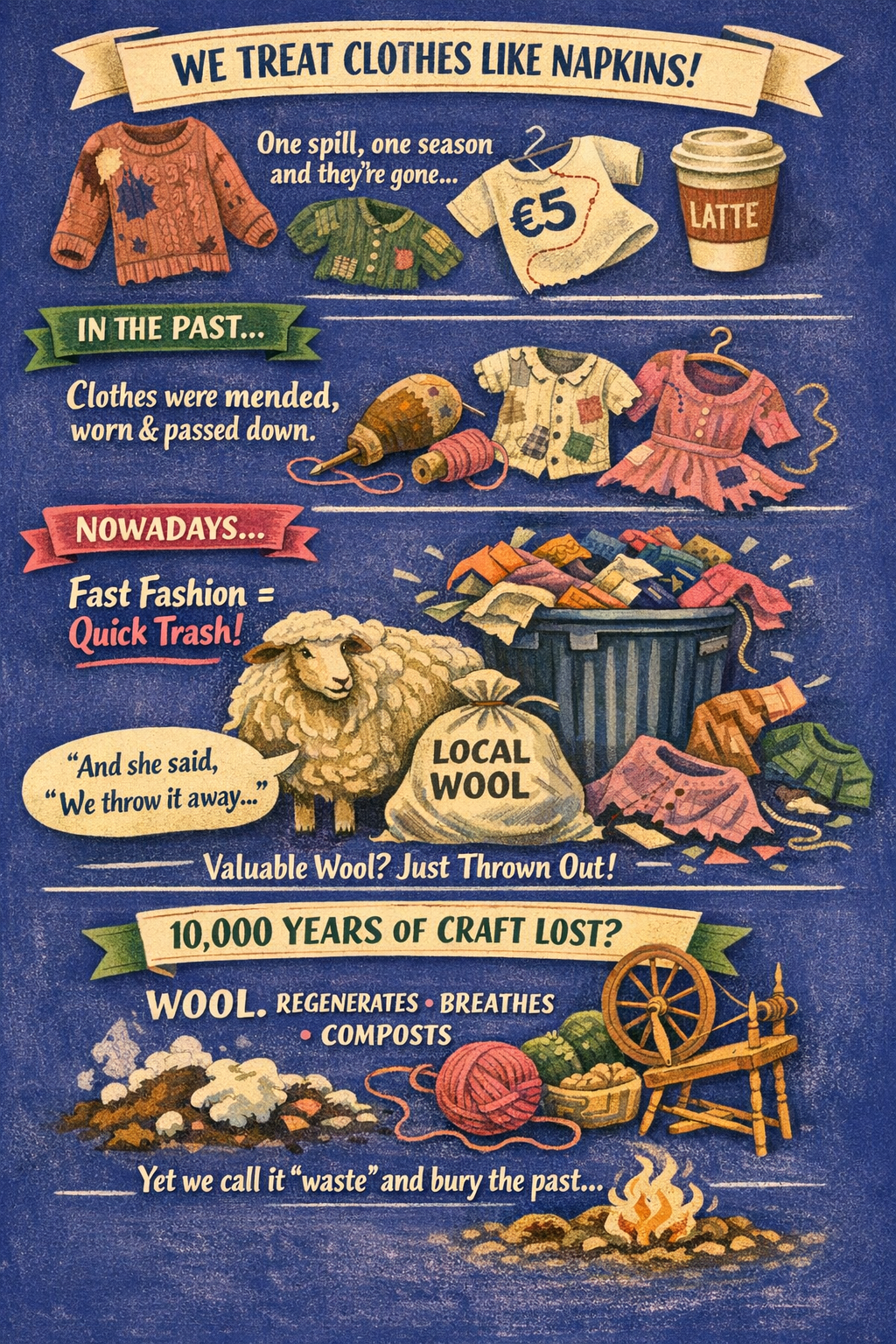
Today, we've flipped the logic completely. And that's why Gabriele makes the contrast. Garments are practically trash before they even reach our closets. Synthetic fabrics stretch, pill or tear after two wears. We call them "new", but they're already a waste in disguise.
Gabriele didn't stop there. She also collected local wool that farmers literally couldn't sell. When she asked one of them what they did with it, here's how the conversation went:
And she said, we throw it away. And I was, you throw it away, why? And she said, yes, because we don't get money for it. And I couldn't believe that. It was very strange for me and I said, what the hell? Such a nice material, such a wonderful material like wool, it's thrown away. And then I said, okay, now I have this waste and this waste and I put it together.
Wool. Thrown away. The thing that kept humanity alive through millennia.
Meanwhile, most wool for fashion today comes from Australia, New Zealand and South America, prized for its fineness. European wool? Often unused, burned or relegated to landscape maintenance. German sheep, for example, are literally rented by cities to mow meadows with their teeth. Their wool isn't "good" enough for the fashion market. It gets burned or buried. Which is wild, because it can also be used as building insulation. It's fire-resistant, naturally regulating humidity and biodegradable.
Wool is basically high-tech nature. It regrows. It breathes. Undyed, it composts back into soil in months, fertilizing the ground.
And it didn't get this way by accident. Over 10.000 years, humans bred sheep for finer, denser, continuously growing wool. Every fleece carries centuries of craft, selection and care. Yet most of that knowledge (spinning, carding, weaving) has been lost.
As machines and factories took over, this slow, careful knowledge of wool that took thousands of years to perfect was largely forgotten.
So when we toss wool aside as "waste" we are not just throwing away a fiber. We’re discarding 10.000 years of human ingenuity and co-evolution with nature and replacing it with a system obsessed with consumption, speed and cheapness.
Now, compare that to polyester: the world’s most common fiber. Made from the same oil as plastic bottles. Taking 200 years to decompose. Releasing microplastics into rivers, oceans, even our bloodstreams with every wash.
If synthetics are so bad, why are we still wearing them? Well… it's complicated, but also kind of obvious. They are cheap, reliable and made to obey: stretchy, quick-dry, wrinkle-free and perfect for factories that needed millions of identical pieces yesterday. Germany started leaning into chemical fibers early because, unlike Britain, they didn't have colonies to supply cheap cotton. Meanwhile, traditional wool knowledge slowly faded: spinning, carding, weaving, it's all slow, messy and expensive compared to pressing a button on a machine. Today, synthetics dominate because they're easy to produce, consistent and can do things wool can't from sportswear to car interiors.
Polyester now makes up 70% of all clothing. It’s the fast food of fashion.
And like fast food, it's cheap, addictive, everywhere… and leaves us sick in the long run.
Also? Polyester doesn't just burn. In a fire, it melts onto your skin. A polyester T-shirt can literally brand itself into your body.
So here’s the real choice:
Do you want your sweater to return to the soil… or linger in a landfill long after you’re gone?
All in all, fashion has a huge problem. It produces more emissions than all international flights and shipping combined. It pollutes water, trashes unsold clothes. A truckload, every second.
And while that sounds distant, the truth is: it’s driven by us. We own more than ever, yet feel like we have nothing to wear. We buy more to fix that feeling and the cycle repeats. I know, because I’ve lived it. Closet full. Nothing to wear. Stress before school, work, events. I thought clothes were identity. Expression. And they are, however not the way fast fashion has taught us. It’s a system design failure.
Buying clothes we use never or once or twice, perhaps ten times, and then we throw it away.
Most people wear only 30% of their wardrobe. And 61% still say they struggle to find something to wear.
That’s why I am builing a styling app. Just like Gabriele preserves old fibers, my app helps you preserve the stories in your wardrobe by styling what you already own, buying only when it truly makes sense. Because Gabriele is right:
Everybody who knows about the topic has to change their behavior. Put a statement in your clothes.
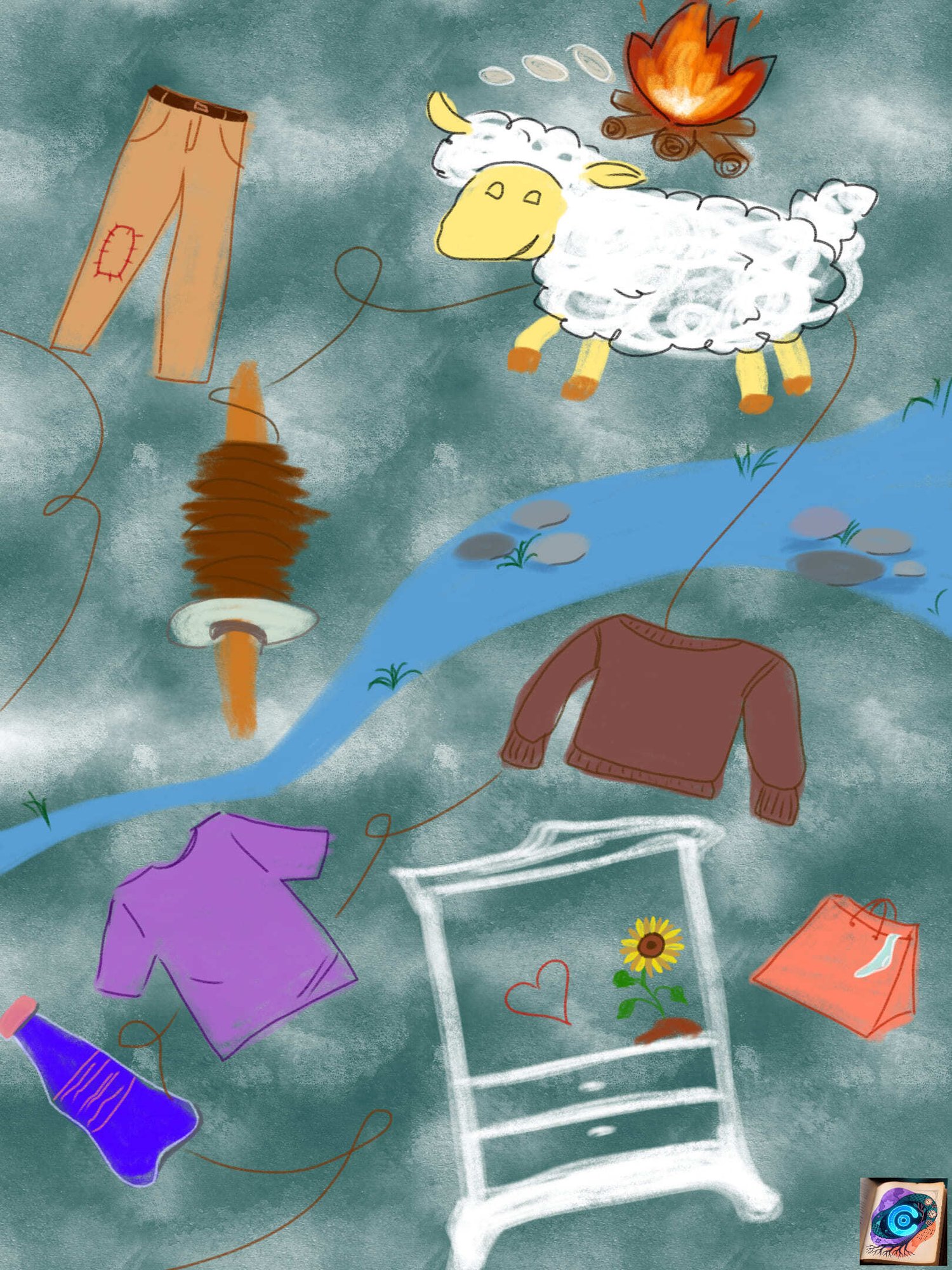
Imagine wearing a jacket made from your grandmother's curtains. Or jeans from a small ethical brand in your city. Or a blouse you mended proudly with red stitches. Suddenly your clothes aren't just clothes. They're a story.
With our clothes, we have the chance to put in a statement.
That's power. That's style. That's identity. Of course, the fashion industry doesn't want this.
There is a brainwashing industry behind fast fashion. Because you can earn so much money with it.
Tiny, unreadable labels. Glossy marketing campaigns. "Made in Italy" tags on clothes that have traveled around the globe at least twice before reaching your closet. We didn't choose this system. But we can choose how we respond. And here's the twist: Gabriele isn't bitter. She's hopeful.
Since 10 years, I see everywhere small companies, groups, young people wearing second hand, making clothes of their own. There are a lot of changes now. So I’m full of hope. I think when we connect, then there will be a change.
Hope doesn't come from Zara or H&M. And hey, no judgment if you shop there. I've been there too. But once you see what's behind it, it's really hard to "unsee". Like Crocs at a wedding, you can't forget it. Hope comes from memory. From reusing. From choosing differently. Maybe the softest thing in your closet isn’t wool. Maybe… it's care.
The system wasn't designed to help us feel good, or whole, or connected to our clothes. It was designed to sell more. To move fast. But Gabriele's message (and maybe this episode too) is here to say: We can do it differently. We can honor materials. Respect resources. Dress with intention, with joy, with care.
We take the best quality of fabric and we get an outfit that really fits us. We can wear it the whole life. We can get a wonderful wardrobe that really expresses our personality, that’s unique, that’s designer quality, nobody else wears it. And in some it would be cheaper than what we do now.
We just need to look closer. And maybe, slow down. So here's your gentle nudge. Next time you open your wardrobe, pause. Feel. Wonder. What story are you putting on? And what would happen if your clothes weren’t just things… but companions on your journey?
And if you want to take this curiosity a step further, Gabriele has a couple of books to share:
We always ask what else can we have, but we never look around what we get for free. We get for free the flowers to grow, the sun, the rain. And the earth never asks what do you give? Our present for the earth is the gratefulness.
If this episode made you pause… if you want more stories like this, more memory, more meaning, more curiosity, join us. This is Curious by Design, a podcast where we explore the stories hidden inside everyday things and the questions we’re still asking about them.
Season one is all about fashion: how it shapes us, how it challenges us and how we can shape it back. Let's stay curious. Together.